The Symbolism of the Crescent: Why Moon-Inspired Motifs Are Trending for 2026
Tonight, millions of eyes will turn to the sky. Across the Gulf and beyond, families will step outside, searching the horizon for a sliver of light that signals the beginning of something sacred. The sighting of the crescent moon — the hilal — marks the start of Ramadan, a month of reflection, generosity, and spiritual renewal that shapes the rhythm of life across the Arab world.
But the crescent has never been confined to the sky. For centuries, it has lived in the curves of gold bangles, the arches of palace doorways, and the delicate filigree of heirloom necklaces passed from grandmother to granddaughter. In 2026, that ancient symbol is experiencing a remarkable resurgence in the world of fine jewelry and luxury design — and the timing could not be more meaningful.
A Symbol Older Than Borders
Long before the crescent became associated with any single faith or nation, it held deep meaning across civilizations. Ancient Mesopotamian cultures revered the moon as a marker of time and fertility. In pre-Islamic Arabia, lunar cycles governed trade routes, harvests, and gatherings. The crescent was not merely decorative; it was functional, spiritual, and deeply personal.
In Islamic tradition, the crescent took on layered significance. It became a symbol of new beginnings — each month in the Hijri calendar opens with the sighting of a new moon. The crescent represents the cyclical nature of time, the promise of renewal after darkness, and the quiet discipline of patience. These are not abstract concepts. They are values that families across the Gulf live by, especially during Ramadan.
When a jeweler shapes a crescent in gold or sets it with diamonds, they are not simply following a trend. They are continuing a conversation that stretches back millennia.
Why 2026 Is the Year of the Crescent
The resurgence of moon-inspired motifs in luxury jewelry is not accidental. Several cultural and market forces have converged to make the crescent one of the most sought-after design elements this year.
The first is a broader movement toward heritage-driven design. Consumers — particularly younger buyers in the Gulf — are seeking pieces that reflect their identity. They want jewelry that tells a story, that connects them to their roots while still feeling modern and wearable. The crescent offers exactly that balance: it is instantly recognizable, deeply rooted in tradition, yet endlessly adaptable to contemporary aesthetics.
The second factor is the growing global appreciation for Islamic art and geometry. International design houses have taken note of the elegance found in arabesque patterns, calligraphic forms, and celestial motifs. Moon-inspired designs have appeared on runways, in architectural projects, and across fine jewelry collections worldwide. What was once considered regional is now recognized as universally beautiful.
The third is the emotional weight of the symbol itself. In a world that often feels uncertain, the crescent represents hope. It is the first light after a dark sky. That resonance is powerful, and it transcends geography.
The Crescent in Gulf Jewelry Tradition
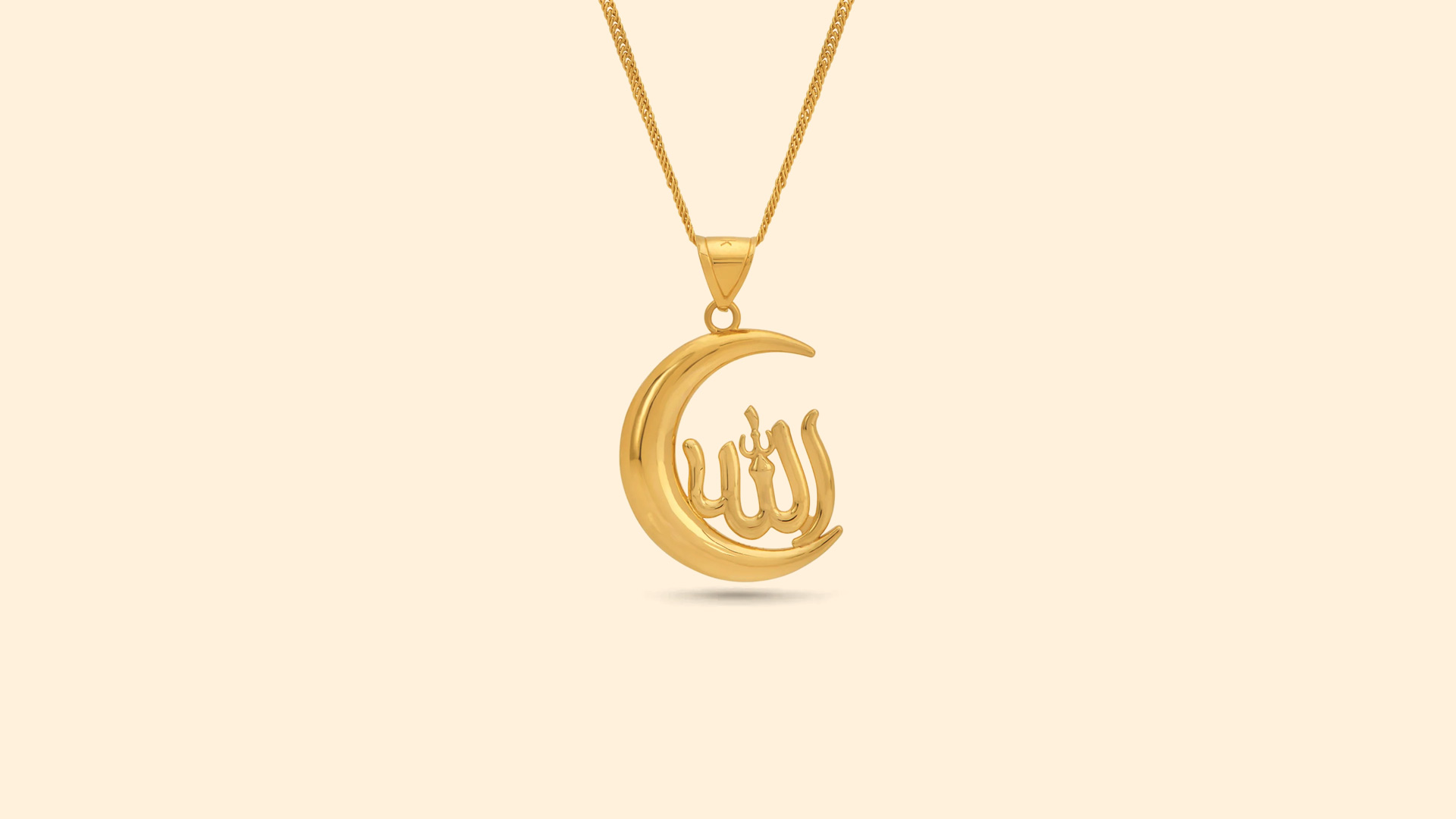
In the Gulf, the relationship between the crescent and personal adornment runs deep. Traditional Bedouin jewelry frequently incorporated lunar shapes — not only for beauty, but as symbols of protection and blessing. Crescent-shaped pendants, known in some regions as hilaliyyat, were worn by brides and passed through generations as tokens of good fortune.
Qatari and Emirati goldsmiths have long understood the emotional currency of the crescent. It appears in heritage collections as bold, sculptural forms in high-karat gold, often paired with turquoise, pearl, or coral — materials drawn from the region's natural landscape. These pieces carry the weight of memory. They recall a grandmother's hands, a mother's blessing before a wedding, the gleam of gold against fabric during Eid celebrations.
Today's luxury jewelers are reimagining these traditions. Modern crescent pieces blend traditional craftsmanship with contemporary sensibility: sleeker silhouettes, mixed metals, pavé settings, and asymmetrical compositions that feel fresh without losing their cultural gravity.
Styling the Crescent: From Sacred to Everyday
One of the reasons the crescent motif has gained such traction is its versatility. A crescent pendant layered with fine chains feels effortless for daily wear. A statement crescent cuff in hammered gold becomes a conversation piece at a Ramadan gathering. Crescent-shaped earrings — whether minimalist studs or dramatic drops — complement everything from an abaya to evening wear.
For Ramadan specifically, crescent jewelry carries a dual purpose. It is personal adornment, yes, but it is also a quiet declaration of belonging. Wearing a crescent during the holy month is a way of carrying the spirit of the season — patience, gratitude, inner light — close to the skin.
Gift-giving during Ramadan and Eid has also fueled demand. A crescent piece makes a thoughtful and symbolic gift: it says I see you, I honor this time, I wish you renewal. For mothers, daughters, friends, and brides-to-be, it is a gesture that goes far beyond the material.
Beyond Jewelry: The Crescent in Broader Design
The crescent's influence extends well beyond the jewelry box. In 2026, we see it shaping interior design, fashion accessories, luxury packaging, and even fragrance bottle silhouettes. Brands that serve the Gulf market have embraced the crescent as a visual shorthand for elegance, spirituality, and cultural pride.
This is not tokenism. When done thoughtfully — when the crescent is treated with the reverence it deserves, rooted in genuine cultural understanding rather than surface-level aesthetics — it resonates deeply with consumers who recognize authenticity.
The Light That Returns
There is something quietly radical about the crescent as a design motif. It is not a full circle. It is not complete. And that is precisely its power. The crescent represents a beginning, a becoming, a light that is growing. It asks us to trust the process, to find beauty in the incomplete, to believe that fullness will come.
As Ramadan approaches and the world pauses to look skyward, the crescent reminds us that the most meaningful symbols are never just decorative. They carry the weight of who we are, where we come from, and what we hold sacred.
In gold, in silver, in diamonds, or simply in the night sky — the crescent endures. And in 2026, it shines brighter than ever.

Download the App & Invest
in Al Romaizan Gold today